 by Schlosser Studio
Dahlia Tuber Book Dahlia Tuber Book
The Dahlia Tuber Book
Records for collectors and small tuber sellers, in two matching forms: one standard .xlsx spreadsheet and a printable binder for the clipboard in the garage. One price, one download, no subscription.
Eleven tabs, in the order you use them
- Start Here
- Varieties
- Beds
- Plantings
- Dig Log
- Storage
- Keep Sell Trade
- Orders
- Money
- Sale Planner
- Dashboard
Type your own records in the shaded cells. The rest are formulas that work out the arithmetic.
- Start Here
- What each tab is for, in the order you use them through the year, and how to clear the made-up example rows. The few numbers the sheets use (twelve inches to a foot, the per-clump and winter figures) sit here with their sources. You can change them.
- Varieties
- One row per variety, up to 400: name, form, color, where it came from, the year, tubers bought and what you paid. Cost per tuber, how many you planted, tubers per clump, winter survival, what you keep, trade and sell, and what sold fill in on their own.
- Beds
- Each bed by length, width, spacing and pattern (grid, staggered or rows). The tubers that fit are worked out with the same sums as the free bed calculator, and the spaces left once you have planted.
- Plantings
- Which variety went in which position of which bed, on what date, with the position numbers matching the plan on the bed page of the binder.
- Dig Log
- One row per clump dug, with room for 2,000 rows across all your years: date, variety, tubers kept. A summary beside it gives, for the dig year you pick, clumps, total kept, tubers per clump, and the lowest and highest clump, for every variety.
- Storage
- One row per variety per box or bag: date stored, tubers in, how you stored them (a record, not a suggestion), the spring count, tubers out, and what you think was lost. Survival is worked out on the same row.
- Keep Sell Trade
- Per variety: tubers available, how many to keep, how many to trade, the rest for sale with your price, and what is left. A one-page price sheet is ready to print or copy into a sale post.
- Orders
- One row per variety per order: date, channel, quantity, price, shipping charged, fees, shipping and packing cost. Line totals and the net of each order work themselves out.
- Money
- Spending that is not on Varieties or Orders: storage supplies, labels, shipping supplies, sale fees, tools, club dues. Pick a category and type the amount.
- Sale Planner
- The free sale planner on one screen, pre-filled, with a cell that can pick up your own tubers for sale from Keep Sell Trade.
- Dashboard
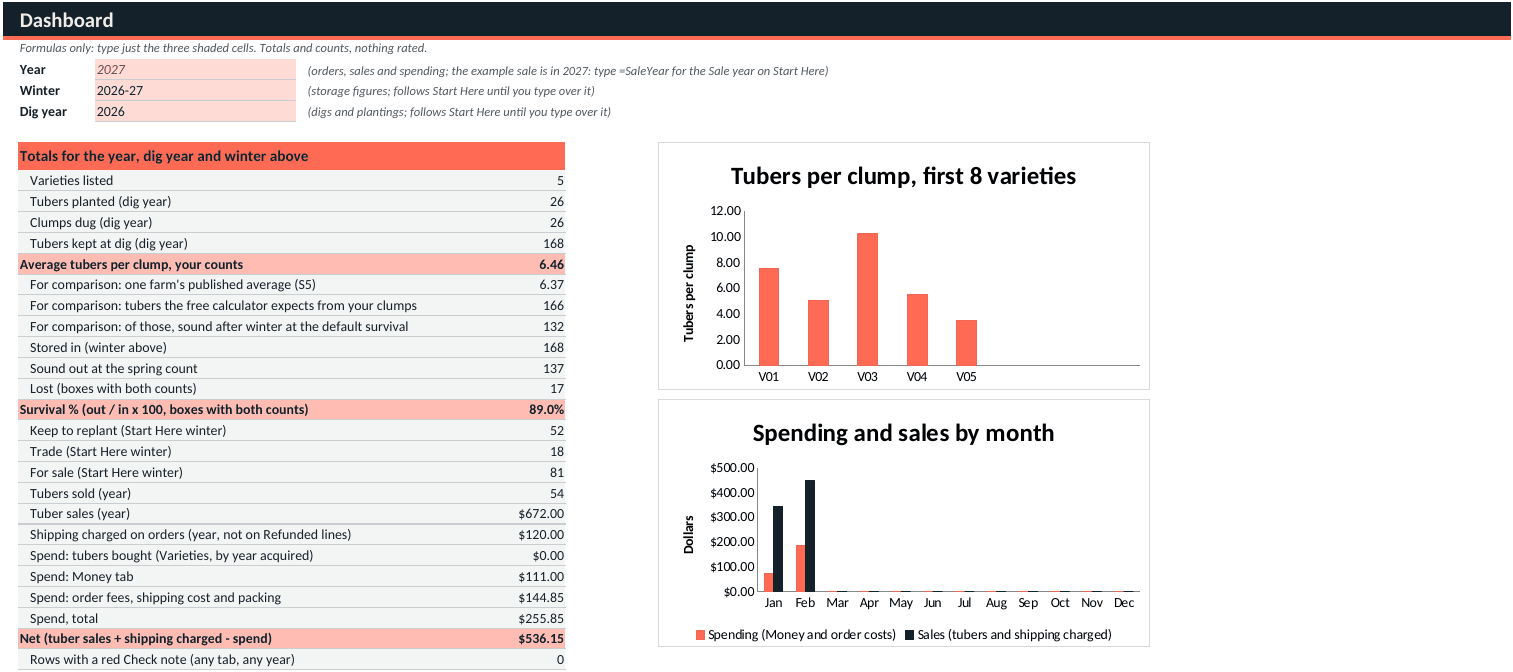
- A year selector and a winter selector. Varieties, tubers planted, clumps dug, tubers per clump, stored in, sound out, survival, tubers sold, sales, spend and net, plus a row for each variety and two charts.
The printable binder
Ten pages in black, white and gray, on US Letter. They print on A4 at 97%. The columns match the workbook tabs, so what you write at the folding table goes into the spreadsheet as it is.
- Cover with the year
- Variety register (22 rows)
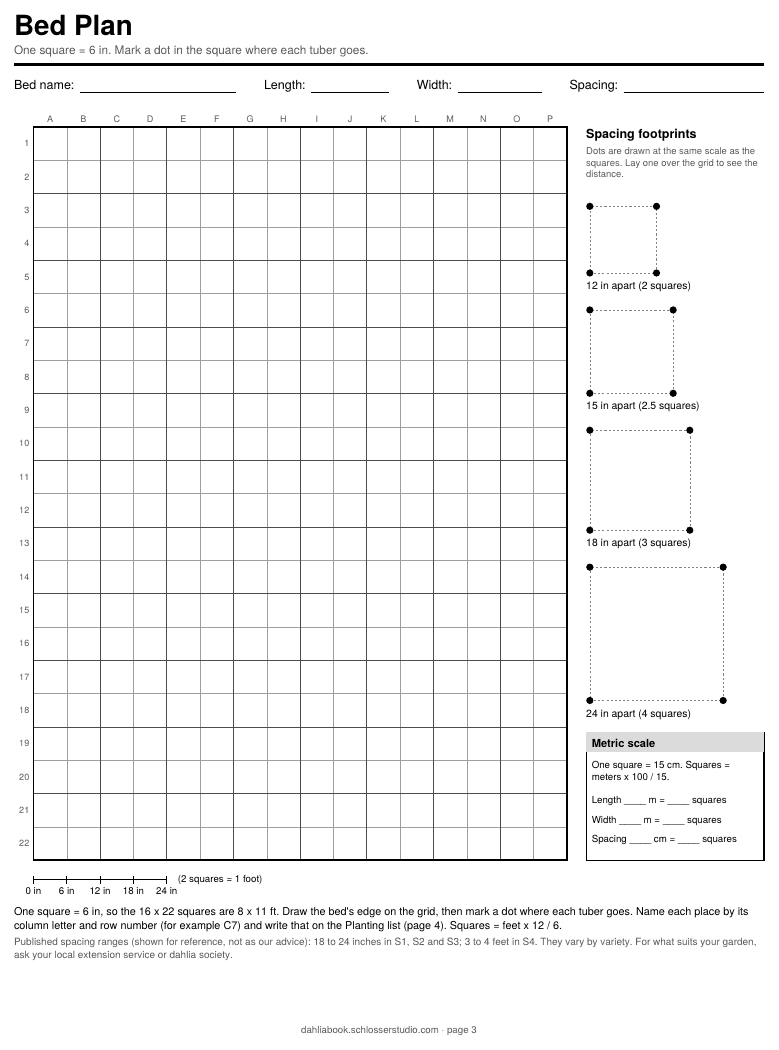
- Bed plan on a squared grid, one square is 6 in, with spacing footprints in the margin
- Planting list (30 rows)
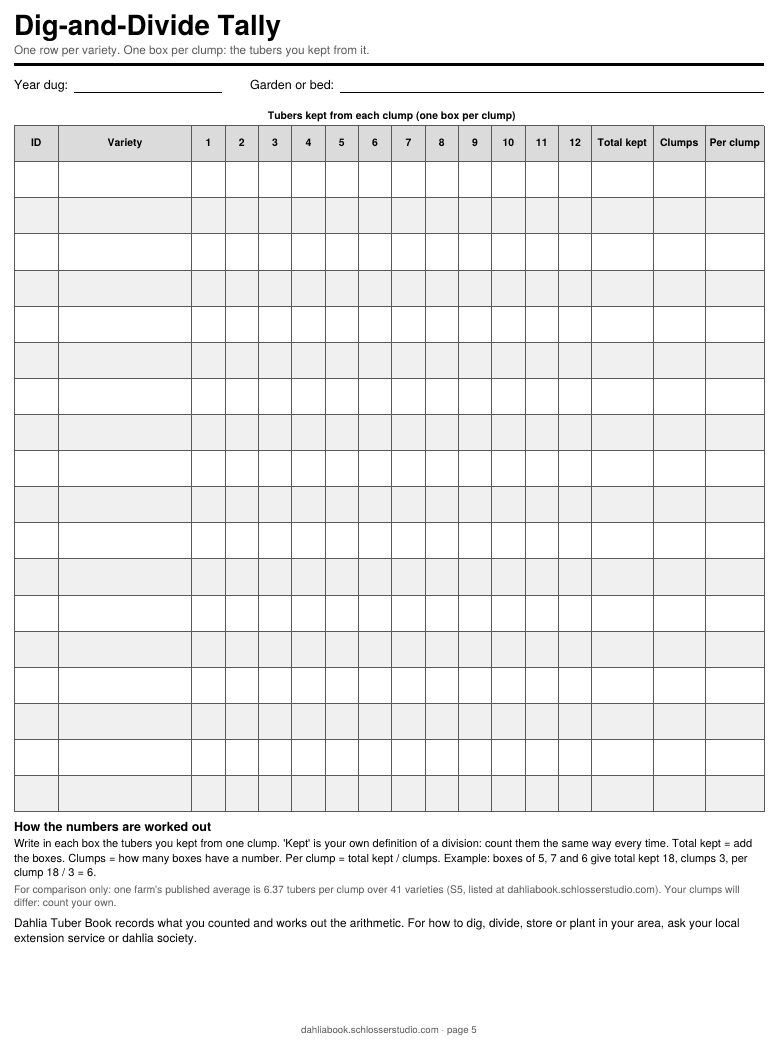
- Dig-and-divide tally (18 varieties, 12 clump boxes each, with tubers per clump worked out at the foot)
- Winter storage check (22 rows, with two mid-winter look dates and a spring count)
- Keep, sell and trade list (22 rows)
- Price sheet to hand to a buyer (26 rows)
- Order list (24 rows)
- Spend and sales (30 rows) with a year summary box
What it looks like
These are pictures of the real files, made from the workbook and the PDF, with the made-up example collection that comes in the workbook. Your own records replace the examples.
Swipe sideways or tap a picture to enlarge


Who it is for
- Collectors who grow 15 to 150 dahlias and keep a garage or basement of labeled tubers over winter.
- Anyone who buys a few new varieties each winter and sells or trades the extras at a club sale, a local pickup or a small online shop.
- People who write counts on masking tape at the folding table and want them to add up.
Who it is not for
- Anyone wanting growing instructions. The book keeps records and arithmetic, nothing about how to dig, divide, store or plant.
- Commercial farms with thousands of clumps and a shop platform: the Dig Log has room for 2,000 clumps in all, across every year, and Varieties holds 400.
- Anyone looking for cut-flower pricing.
What you get
- One standard .xlsx spreadsheet that opens in your spreadsheet app: no macros, nothing to enable.
- A 10-page printable binder on US Letter, or A4 at 97%; a black-and-white printer is fine.
- You get the files the moment you pay, on a download page. You can edit every tab; nothing is locked.
Questions before you buy
- Will it fit my collection?
- It holds 400 varieties and 2,000 dug clumps in all, across every year you record. Most collectors have a fraction of that.
- Can I edit it?
- Yes, every tab. The shaded cells are for you; the formulas are not locked, and a note says which is which.
- Do I need the printable pages?
- No. They are the same pages as the spreadsheet for people who like paper in the garage. The dig and divide log and storage check are free on this site as well.
- What if it is not right for me?
- Email us within 14 days for a full refund. The wording is in the box above.
- What do I need to open it?
- A spreadsheet app that opens .xlsx files. Any PDF viewer opens the binder.
What it is, honestly
What it is not
- It is records and arithmetic only: it adds up and counts what you type in.
- Dahlia Tuber Book records what you counted and works out the arithmetic. For how to dig, divide, store or plant in your area, ask your local extension service or dahlia society.
- Dahlia Tuber Book gives no advice on when to dig, how to divide, what to dip or dust tubers with, or how to store them. For that, ask your local extension service or dahlia society.
- Spacing and per-clump numbers are published figures with their sources beside them, never our recommendation.
- No color ever judges a count: the sheets work out the number and stop there.
- The example varieties, counts and prices in the file are made up. They show how the sheets work. They are not real records or typical results.
How it was tested
It is a standard .xlsx file with no macros and no protection on any sheet. Its formulas were recalculated and checked against an independent calculation, including the bed counts over hundreds of random sizes. If something looks wrong, please email us and tell us what you see.
Made by Schlosser Studio, a studio whose products are built and maintained by AI assistants.